15 December 2022
When discussing important parts of Pittsburgh’s culture, jazz comes to mind as a particularly important historical and present practice. Jazz is a primarily spatial practice that depends on its spaces and communities to foster and create music. When urban renewal and other policies swept the nation with the promise of progress, the spaces in which jazz was created radically changed. This piece explores how these communities are formed, how policies have changed where these communities go, and ends with how Pittsburgh continues to transform and grow its important, illustrious jazz history. The story is told through research and stories told from practitioners of Pittsburgh jazz, who have lived all of these experiences.
May, 1956.
One day, 3 miles of shops, businesses, and music clubs stretch into Wylie Avenue in the Lower Hill of Pittsburgh, a neighborhood nestled beyond the industrial downtown bustle. The next day, rubble replaces the lights from the dynamic district. A wrecking ball ordered by the City of Pittsburgh barrels through people’s livelihoods. The destruction was encouraged by policies promising “half of the 1,800 families living in the Lower Hill will be relocated; that 90 percent of 970 parcels of property will be acquired; the land will be cleared for the construction of both the new public auditorium and Crosstown Boulevard” [1]. Shame if you were part of the 1,800, shame if you were a part of the predominantly black community of the Hill District, shame if your church, home, and school were reduced to dust, cleared for ‘promise’. Shame if you were a black jazz musician, where your space for your art, livelihood, and craft became memories clouded by the dust.
May, 2022.
A symphony hall, an opera house, a hockey arena, dozens of restaurants, niche Pittsburgh-themed stores, banks, and looming business towers sprawl over what once was the rubble left behind. Between the Allegheny River and Heinz Hall, you can still hear it: it’s jazz, that’s what it is. People of any creed, color, and background stand on the stages of Con Alma Jazz Club, reclaiming what it means for Pittsburgh to have a vibrant jazz scene. The tapping of feet, swinging of souls, the beating heart of the city found its way back, although it required a formidable journey between the years of 1956 and 2022 to keep its place in the city. To honor this journey as readers and residents of this city, understanding how space is the lifeblood of the communities of jazz and how the practice endured massive transformation because of urban renewal policies is how we can continue the legacy of Pittsburgh jazz today.
Part 1: Constructing Communities, 1940 – 1956
Referring to jazz as a ‘spatial practice’ is crucial to understanding how certain policies affected its position in the city. The term in this context is defined by Colter Harper in his doctoral dissertation at the University of Pittsburgh and the definition reads: “As both born from and a force in constructing the social spaces, physical places, and economic contexts in which it was performed” [2]. The definition explains how important space is to this improvisational practice, and this definition will be crucial as we examine the personal experiences within these communities and those who have bonds fostered in environments that allowed for jazz to flourish.
Dr. Nelson Harrison is a Pittsburgh jazz legend and a key member of the Pittsburgh jazz community. Born in the East End of Homewood on December 12th, 1940, his home was one that consistently had the talents of Erroll Garner, Duke Ellington, and other jazz stars oozing from the record player. When his older brother began playing the trumpet, Nelson’s fascination with performance began. Without private lessons or teachers, the brothers attempted to make a sound on the funky looking brass horn. Not much luck became of it; blowing air into a trumpet did not immediately turn them into Dizzy Gillespie. However, their friend Paul down the street had some trumpet knowledge, so they walked over, instrument in hand, and learned how to buzz.
While his brother practiced, Nelson sat against a wall listening to him play, taking note of each squeal and squawk. When he finished practicing, Nelson would pick up the trumpet and repeat what he heard, and, without ever taking a formal lesson, at the age of 12 he was good enough to get into the 9th grade band. A year later, other school and neighborhood friends got the bug for music too, and formed a band coached by Warren Watson. It was called the Beethoven Bebops, because, obviously, they could play everything from Beethoven to bebop.

Above: The Original Beethoven Bebops L-R; (seated) Richard Holland, Jack Kelly, George Green, Curtis Jennings, Hiram Baker, Donald Lee, (2nd row) Delmar Lee, bill Smalley, Richard Harrison, Bill Davis, Nelson Harrison, (standing) John Shropshire
“He (Warren) became my mentor, my main music mentor. He’s still living, he’ll be 100 years old in February and he still plays. Every time I talk to him, I get a music lesson. I always refer to him as the person who taught me everything I know about music, but he didn’t teach me everything he knows” [3]
Nelson let out a chuckle before continuing to recount his other mentors. It was commonplace amongst this network of friends, neighbors, and colleagues to gather around a turntable and listen to all sounds of jazz echo out of the speakers. The older musicians in the community would practice in their homes, and where they were, Nelson and his peers were sure to be sitting on the sidewalk carefully listening and trying to pick up their moves.
It was the kind of neighborhood where every house had a piano, and no one was afraid to participate in that community. High school Nelson sat fumbling over the piano keys in his home when a knock on the door interrupted his flow. “I hear someone playing the piano, can I come in?” Of course, Nelson said yes, without thinking or wondering who it was; it wasn’t the neighborhood to be afraid of your neighbors. He recognized the mystery pianist as a brother of someone in his class, and with little words, he sat at Nelsons piano and showed him how to play the lick he was attempting. It was the time where music was everything everyone wanted to do, and if you could do music, you were a somebody [3].

Above: Judge Warren Watson, Dr. Nelson Harrison
Dr. Harrison was 13 when he began playing in Pittsburgh clubs, his first gig being a trade of 25 dollars for himself, a guitar player, a drummer, and a bassist to play for a dance at Ross’s Inn on route 51 South near Clairton. That same club regularly feature the Bobby Jones Trio, a group of musicians Nelson and his bandmates practically worshiped. Throughout the evening they snuck out on breaks to watch the trio in the lounge, and on their breaks the Bobby Jones trio would repay the favor. Nelson finished at midnight, but the trio continued jamming until two in the morning, so they invited Nelson to sit in with them. In that moment, Nelson reached heaven, or at least what heaven looked like for a thirteen-year-old aspiring jazz musician.
The Bobby Jones Trio members became mentors, watched Nelson grow, and every time they’d run into each other, they’d leave behind pearls of wisdom in his pocket. Throughout the years they became colleagues and played in bands together [3]. These are the stories of many jazz musicians in Pittsburgh, who relied on these spaces, neighborhoods, and opportunities to share, inspire, and practice their craft.
Section 2: Policy & Transformation 1955 – 1980
When space is so integral to cultivating a practice such as jazz, the changing nature of these spaces have long-lasting effects. In the beginning of Dr. Harrison’s career, jazz clubs sprawled all over the Steel City. About twenty clubs populated East Liberty, ten lived in Homewood, but by far the greatest concentration of jazz clubs existed in the Hill District, with upwards of thirty-five being active in the 1950’s [3]. A particular corner of the Hill District was so active it was deemed “The Crossroads of the World,” which was where Fullerton Street and Wylie Avenue met [2]. Dr. Harrison described it as the most happening place in the world. It was open all day and all night, a safe place that respected jazz, and gave a space for black musicians to collaborate and perform. Crawford Grill No. 1 was one of these clubs on lower Wylie Avenue before the crossroads [3]. Directly across Wylie from the Crawford Grill was the headquarters of the black musicians union, Local #471 of the American Federation of Musicians, where touring musicians who wanted to hook up would go there for the greatest jam sessions tucked away in Western Pennsylvania [4].

Above: Crawford Grill No. 1 with fence erected for demolition
The marker of change for jazz in Pittsburgh begins here. First, the wrecking ball struck the Lower Hill district in 1956, an act of destruction masked as progress. Pittsburgh was one of many cities in the United States that became part of urban renewal projects that rarely lived up to its promise. Urban renewal can be broadly defined as “the process of seizing and demolishing large swaths of private and public property for the purpose of modernizing and improving aging infrastructure. Between 1949 and 1974, and the U.S. government underwrote this process through a Department of Housing and Urban Development grant and loan program” [5]. Pittsburgh’s urban renewal was meant to create a Center for the Arts and garnered private pledges of nearly $100,000 for construction. The Hill was perceived as a prime location seemingly ripe for renewal. It had nothing good going for it in the eyes of many, who characterized it as filled with architectural blight and vice[1]. As described by one Pittsburgh Councilman, the buildings in the Lower Hill were substandard and “….have long outlived their usefulness….there would be no social loss if they were all destroyed” [1]. The Pittsburgh press claimed, “The Hill…was completely worn out, like an old pair of shoes that has gone the last mile” [1]. Critics of these mid-century policies were not enough to stand in the way. Bob Pease, the director of the Urban Redevelopment Authority in the late 50’s and 60’s justified his plans, stating that demolishing buildings and relocating people “…are hard things to do. You have doubts, but you do the best you can to achieve the results you want to achieve. Things are never perfect” [6].
Specifically in Pittsburgh, the primary goal of the project was to connect the Hill to the surrounding areas through improved housing, transportation, and street design. Several site analyses were done to the 95 acres claimed to be renewed, discussing how the interstate isolated the community and strived to increase connectivity. The development plan centered on these five main principles: creating a biophilic community, making it walkable, creating connections, making it dense, and providing choices [7]. Unfortunately, this supposed utopia had to first destroy what was left of the already thriving environment there, and the design hardly accommodated for reparations. There was no question the Hill needed something, some way of lifting back to what it was. Urban renewal that created more expensive housing was the chosen answer, and while for city planners the pros outweighed the cons, the cons certainly outweighed the pros for Pittsburgh’s jazz musicians.
The consequences of urban renewal, in and out of Pittsburgh, resulted in the destruction of historic structures, the displacement of low-income families, and removal of small businesses [5]. These small businesses were often community spaces, like jazz clubs, and the removal of these spaces squashed any hope of displaced families moving back; what would they go back to? An unwelcoming community of gentrified homes and businesses? There was no longer a home to return to, at least not a home they could recognize. Though new housing in the Hill was promised, it wasn’t until the late nineties that the Pittsburgh Urban Redevelopment Authority built a development, long after the displaced residents would have been able to benefit from it [1].
While urban renewal was the catalyst for change in Pittsburgh jazz, it was not the only factor. When the Lower Hill was torn down, Local 471 (the black musicians union) made its new home in East Liberty. This relocation occurred a mere ten years before with the merger with the white musician’s union, Local 60 [4]. Neither group wanted to merge, but by a slim margin by vote, one of the most destructive decisions regarding the livelihood of black jazz musicians was made [3]. Since the black union had 400 members while the white union had 1600, they had little power or say when it came to finding work, whereas before the merger, there was little competition between the two for work. Local 471’s records were burnt to a crisp, and with the loss of space for black musicians to work, other places weren’t hiring. A lot of the musicians considered the best in the field quit during that tumultuous time, because without gigging money, food needed to be put on the table via a day job [3].

Above: Modern day image of PPG Paints Arena, less than a mile away from where Crawford Grill No. 1 stood on Wylie Ave.
Section 3: Space, Psyche, and Rebuilding 2019 – 2022
This piece could be about jazz anywhere, but because of the changes specific to the city as well as the atmosphere of jazz here, Pittsburgh remains unique in its position in jazz history. Dr. Nelson Harrison’s sentiments about Pittsburgh show this, claiming that after traveling all the way around the world, Crawford Grill No. 2 was still his favorite place to play. He led his first quintet there to an audience of mentors and music-appreciators who seemingly knew as much about the music as any expert would. There is a conversation between the audience and the performers, an unspoken one that requires careful attention to the energy in the space. While Colter Harper’s definition of jazz as a spatial practice focused more on the physical spaces in which jazz was performed, Dr. Nelson Harrison added to his definition with his thoughts on it being a space within the mind. A certain psyche is required, differing from other musical performances that often remain cerebral within the own performer’s mind. Jazz requires a space for that frequency to occur, as best explained in the words of Dr. Harrison reflecting on his time in the Count Basie Orchestra.
“When the Count walks on stage, you don’t know what the first numbers gonna be. He sits down on the piano, boom! He starts to play. And what he plays tells you what the first numbers gonna be. And sometimes, he’ll change his mind right in the middle of it. He’ll start to play one thing, and pfft changed his mind and go on to another thing. And you’re just sitting there, waiting for him to decide what the first number’s gonna be, and he’ll play a couple choruses of it with the rhythm section, right? And then when he’s sending a signal out, an auditory signal out that this is what the chart is gonna be…you’ll spend 4-6 choruses swinging in your seat, you’re just swinging to the rhythm section that by the time you pick up your instrument you’re at the left hand corner, you’re already swinging, okay? And what comes out of your instrument is like wow, its magic. And I used to literally say, I can’t play like this…Because what would happen is his aura would envelop the whole band and it becomes an organism. And once you’re in that envelope (space), you’re doing magical things that you don’t know how to do, you know? You take that same chart and you give it to an author like Sammy Nestico, you can listen to the Sammy Nestico band play that same chart and listen to the Basie band play that same chart, two different worlds. Because there’s something going on in that space that has nothing to do with what’s on the page” [3]

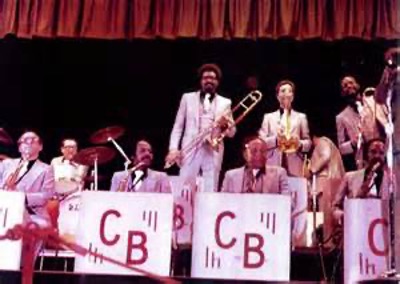
Above: Dr. Nelson Harrison & Count Basie & Dr. Nelson Harrison in the Count Basie Orchestra
The city of Pittsburgh went through massive change over the past sixty years, and the jazz community is clearly no exception. Despite the practice’s changing nature, the hunger for music never left the city. Dr. Nelson Harrison remained an active musician until the dawn of the COVID-19 pandemic, and now spends his time writing and documenting Pittsburgh’s illustrious jazz history. Pittsburgh remains an important city in touring jazz circuits, and some are particularly dedicated to preserving the Pittsburgh jazz legacy through space.
Con Alma, which directly translates to “With Soul,” began as a small, speakeasy type club on Ellsworth Ave, founded in 2019. Inspired by the rich heritage of jazz in the city, their mission is to return jazz to its rightful place at the forefront of the local music scene while providing a space for musicians to thrive [8]. The music curator of the club, John Shannon, is an integral figure in understanding the role of jazz in the city today. John grew up in the South Hills of Pittsburgh, playing and taking guitar lessons all throughout his early years. By the end of high school, he was already heavily involved in the Pittsburgh jazz scene both as a performer and teacher, introduced by an old school drummer, Spider Rondinelli. After studying jazz in Boston, John remained in New York City and toured elsewhere for twelve years before returning to Pittsburgh.
“I started connecting back with all the people from the scene here and all the people I knew from high school, and I saw that the scene was really strong, and the players were really strong, and there was an audience for music. Yet, there wasn’t really a center for it, cause James St. Tavern, that was the place I grew up on, closed and was kind of the last one. Another reason we wanted to start this was just to honor the past, you know, honor the legacy of Pittsburgh, cause you know Pittsburgh loves to be proud of Pittsburgh” [9]

Above: Con Alma Downtown bar
Seeing the need for a new home for jazz, Con Alma opened with an opportunity to show off this local scene that stretched into the past, and it became a hub of performances for local practitioners as well as touring groups. With their found success, they took the opportunity to open another space that became available during the pandemic, right across from the prestigious Heinz Hall to push jazz into the heart of the cultural district where it belongs. Because of this designated space for jazz, music was no longer happening in the corners of rooms, hotel bars, school events, but rather on the main stage parallel to one of the most famous orchestras in the world. The place provides a center for talent to blend in the heart of the city, and every night they are open there is seldom an empty seat in the club. As someone who both performed in spaces of jazz and provided one, John had interesting reflections on jazz as a spatial practice:
“You know what I often say to people in relation to me because space is the circle. The thing about jazz music that, say is different than rock ‘n’ roll songwriters, when you perform you perform on stage straight at the audience, like you just go at them. Jazz is this conversation that happens on the stage, and it emanates out into the space, which makes it really cool for something like this that isn’t forced listening, cause you can tune in or out, it’s never abrasive, so in that way, it’s a spatial practice. Also, it being an improvisational artform, anything that is improv is feeding off of elements in the surroundings which makes it spatial in relation to the space it’s being played in” [9]
Apart from Pittsburgh jazz’s’ rich history, opportunity, and perseverance, the musicians chalked it up to something quite indescribable about the city that provides such an atmosphere. Being in these spaces is the most effective way to witness these difficult to describe qualities, and Con Alma is the perfect place to observe. You can certainly pick up on the intimacy within the spaces. The dark walls are adorned with glowing lights in the ceilings, hung in cloud-like lanterns. Each table, positioned right beneath the raised platform (the stage), had a candle and small vase on it. Before performances, you can hear musicians noodling on their instruments to warm up, as John’s record of choice will play before it was time.

Above: Con Alma Ellsworth seating area & stage
The downtown location is a louder, more engaging location to visit. Visitors can still chat with who they came with, but the musical atmosphere intensifies and adds a new layer to the conversations. In the Shadyside location, eyes are glued to the performers, almost not daring to stare too long at the awe-inspiring creators. There is a closeness, both physically and mentally, in those dark rooms as velvety notes pour from their respective instruments. John’s performance began as the lights dimmed to a deep purple, and like that, he was on, and seamlessly began to pluck the strings of their first set, “Steel City Alley Cat.” There was a funk in their faces as well as in their sound, and slowly the audience’s body language began to mirror theirs. The space provides a stimulus of all five senses, six if you count your level of intoxication. The audience shares in this stimulus, even without speaking a single word to the stranger beside them. When you leave, the noises and lights of downtown seem incredibly abrasive in comparison to the warm space Con Alma provides.
The policies that impacted the practices of jazz did not erase it. The Pittsburgh scene as it stands today remains a prideful and important jazz city. Continuing this legacy and understanding it are the final pieces of the puzzle. Visiting Con Alma or any other fantastic Pittsburgh clubs, listening to Dr. Harrison on the Pittsburgh jazz radio, and a continued effort in education are all parts of honoring this legacy. Jazz does not have to be a niche practice reserved for those who claim to ‘get it’; Pittsburgh jazz welcomes those who are both experts and those who are curious. Perhaps after reading this, you can visit these spaces with a newfound understanding, appreciation, and adoration, and look at policies surrounding the renewal of spaces with a holistic understanding of what it means to transform a space.
Thank you to Dr. Nelson Harrison for sharing his life experiences and wisdom with me. Without his help, I would not have been able to chronicle the story of Pittsburgh jazz history.
References:
[1] Sue Morris. “The Lower Hill District and Civic Arena”. The Historical Dilettante. August 2, 2012
http://historicaldilettante.blogspot.com/2012/08/things-that-arent-there-any-more-lower.html
[2] Colter Harper. ““The Crossroads of the World”: A Social and Cultural History of Jazz in Pittsburgh’s Hill District, 1920 – 1970”. D-Scholarship at Pitt. 2011.
http://d-scholarship.pitt.edu/7397/?display-tab=artifact-wikipedia
[3] Dr. Nelson Harrison (musician, composer, educator, jazz historian). In discussion with author. Pittsburgh, Pennsylvania. September, 2022.
[4] Colter Harper. “The Paradox of Progress: Jazz, Resistance, and Black Musical Labor in Pittsburgh (1955 – 1974)”. Jazz Perspectives. October 18, 2018.
https://www.tandfonline.com/doi/full/10.1080/17494060.2018.1532922
[5] Ann Pfau, David Hochfelder, Stacy Sewell. “Urban Renewal”. The Inclusive Historian’s Handbook.
[6] Dan Fitzpatrick. “The Story of Urban Renewal”. Pittsburgh Post-Gazette. May 21, 2000.
https://old.post-gazette.com/businessnews/20000521eastliberty1.asp
[7] Udday Shankur Datta. “Reviving the Hill, One of the Oldest Residential Neighborhoods in the Steel City”. The Field. January 26, 2021.
[8] “With Soul, Con Alma’s Mission”. Con Alma. 2019.
https://www.conalmapgh.com/story
[9] John Shannon (music curator of Con Alma). Pittsburgh, Pennsylvania. September, 2022.
 Policy & Political Review