October 18, 2025
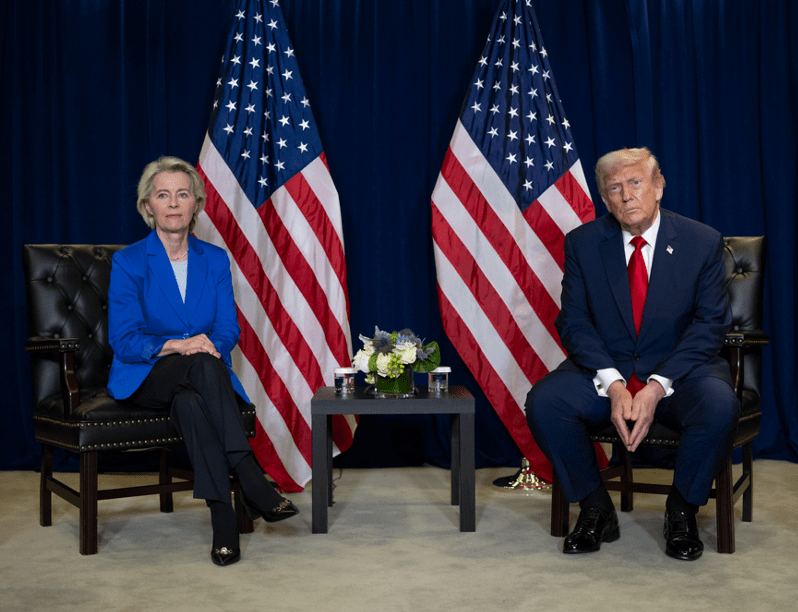
President Donald Trump participates in a pull-aside meeting with Ursula von der Leyen, President of the European Commission, at the United Nations Headquarters in New York City, Tuesday, September 23, 2025. (Official White House Photo by Daniel Torok)
The United States is shooting itself in the foot by isolating itself from key allies in the name of strength. Europe is facing increasing aggression from Russia and instead of turning to America, European countries are instead centralizing their strategy. Canada no longer trusts the United States as a firm economic partner – and is even turning to our enemies in a bid for stability. This article details the immediate effects of America’s sudden policy shift under President Trump and argues that these effects will last into long our future, diminishing the role of the United States in the global order. Strong international partnerships ensure American interests are put first on the global stage and promote peace world-wide; Isolationism is straining international institutions, ostracizing friends, and empowering enemies – and it can only spell disaster for America’s future as a superpower.
The United States has long maintained a tradition of keeping strong allies. From Marshall Plan beneficiaries forming anti-communist allies across Europe, to strong continental treaties like NAFTA and international alliances headed by the US like NATO, tight global friendships have been central to American foreign policy for decades. Strong friendships help to spread America’s influence globally and almost always offer countless benefits for all parties involved, especially in defensive alliances. This long-standing policy, however, has taken a sharp turn in recent months. Ever since President Donald Trump assumed office, his “America-First” policy has shocked the world, inciting protests and ostracizing key allies, especially in Europe and Canada. Europe’s rearmament and Canada’s branching out to new friends exemplify America’s forfeit of leadership; key US allies are finding their place in this dynamic global order by looking to new friends for economic and military support. The influence of the United States through alliances and positive foreign involvement keeps us strong, and turning to isolation will prove a major blunder.
It ought to be made clear that the President’s foreign policy stance isn’t a specifically targeted one, as much as a newly realist approach. But why this change in America’s historically friendly foreign policy attitude towards friends like Europe? Why now? The answer has everything to do with the President’s governing instincts and domestic politics. The President’s so-called “America First” agenda was an integral movement to his campaign last November. Part of this process involved a promise to end the war in Ukraine and other foreign involvement as soon as possible, so that American tax dollars could be focused on the domestic issues again. All of Trump’s promised policies harmonize with the reprioritization of America as the primary concern of the executive branch, appealing to everyday Americans who felt that they had been abandoned in favor of the interests of the elites. Despite the domestic appeal of such bold actions, forfeiting international US influence undermines our leadership and allows our adversaries to fill in the gaps.
The meeting held between European leaders and President Trump this past August embodies this foreign policy shift towards Americentrism. The meeting served as both a photo-op and a discussion on coming together to end the war in Ukraine. Strikingly, photos from the event show European leaders sitting together at the President’s desk, all facing him. The Placement of these figures facing the President underscores the way he views US allies and the world order, with America at the head and its allies as subordinates. [WA1][14] The President’s “America First” agenda is alienating key allies, and their patience will only hold for so long.
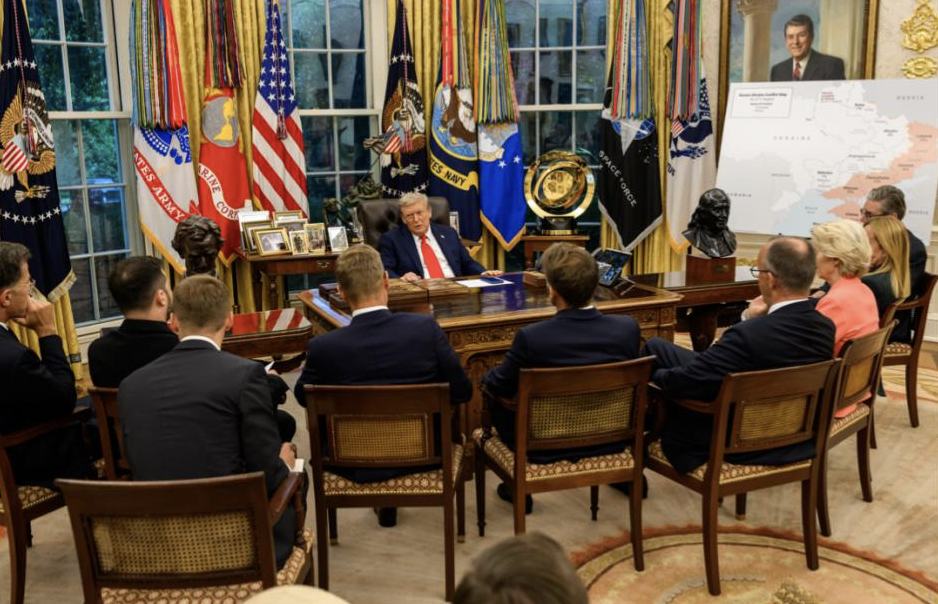
President Donald Trump meets with NATO Secretary General Mark Rutte, Ukrainian President Volodymyr Zelenskyy, Finnish President Alexander Stubb, French President Emmanuel Macron, German Chancellor Friedrich Merz, European Commission President Ursula von der Leyen, Italian Prime Minister Giorgia Meloni, and U.K. Prime Minister Keir Starmer after his call with Russian President Vladimir Putin, Monday, August 18, 2025, in the Oval Office. (Official White House Photo by Daniel Torok)
The test run of this new America-first policy came earlier this year when the President and Vice President met with President Zelenskyy. The meeting between the two leaders devolved quickly. The President and Vice President, JD Vance, began criticizing President Zelenskyy, belittling him for not being thankful enough for US support. The talks came to a close when Zelenskyy left the White House and called off the events that were supposed to follow. This marked the beginning of the President’s aggressive turn on key allies, especially throughout Europe, and foreshadowed what was to come. Public admonishment of allied leaders, especially one whose country is being invaded, undermines American solidarity and leadership, diminishing the US’ image internationally.
Following President Zelenskyy’s embarrassing encounter in the Oval Office came an onslaught of support for Ukraine from European leaders, who reiterated their firm
Russia has continued its violent invasion of Ukraine for over three years now, and every attempt to negotiate a ceasefire has fallen through. President Vladimir Putin appears to have no intention of halting his campaign in Ukraine. This was made evident by the presence of Russian drones in Polish airspace in early September [7]. Poland responded by quickly taking these drones down and invoking Article 4 of NATO, calling a meeting with top allies to discuss further action [11]. European leaders also expressed their support for Poland and Ukraine, reiterating their commitment to defense of their allies in NATO. Increased aggression from Russia begs the question: How will Europe respond if America’s support is not guaranteed?
The answer is they will rebuild. The White paper for European defense – Readiness 2030 – lays the framework for an armed Europe, promising the slicing of red tape provisions in defense production and increased investment into military budget. The White paper also lays out plans to ensure rapid deployment of troops and armament in the event of emergency. [3] Not only is the European Union taking action to prepare for potential Russian aggression, but individual nations are preparing as well. The German government is preparing to strengthen military recruitment, with a bill passed to encourage service. The goal is set at over 100,000+ reserve troops ready to support Ukraine, Germany, and NATO if necessary. [2] This development is of course especially notable because of the German military’s dark past and speaks to the urgency of the German government’s concern of war. The French government has also created and begun to widely distribute pamphlets featuring emergency survival instructions in the event of war. [1] In August, NATO allies agreed to commit 5% of GDP to defense by 2035, compared to the previous 2% requirement [8] Seemingly a direct response to America’s wavering support for its allies, the commitment to increased defense spending both soothes President Trump’s complaints of Europe not carrying their weight defensively and could bolster Europe’s defense from invasion by more than double. Europe knows that it can no longer always count on its closest ally, and it’s preparing for the worst; defeat is not an option—they must act.
The next major shift in foreign policy was tariffs. Implementing widespread tariffs on our closest allies is part of a new approach to trade which seems to be rooted in the President’s discontent with “handouts” and desire to reinvent American trade by forcing other nations to the negotiating table. President Trump campaigned on his plan to balance the scales between America and its trading partners by implementing sweeping tariffs on a litany of other nations. These tariffs were finalized and announced on April 1st, 2025, the so-called liberation day for America. Alongside other key American allies, the European Union was hit with a 20% tariff on all goods, which has since been altered in a deal. Following liberation day, President Trump threatened to raise these to up to 30% across the board if a deal was not made [9]. A meeting between EU commission President Ursula von der Leyen and President Trump in July established a 15% ceiling for tariffs among other provisions which were seen as damage-control measure [9]. Von der Leyen knows that the President can be unpredictable and arrogant, and she played into that by doing what she could to limit the
It’s clear that the world is shaken by this new administration. President Trump’s sharp turn on American allies will not be forgotten and has the potential to reshape the global power structure which America has dominated for so long. Europe is not alone in this struggle; the effects of the Presidents trade war are already being felt by one of our closest allies, Canada. Prime minister Carney said in September that “The United States is fundamentally and rapidly transforming all its trading relationships. And the effects are both immediate and profound [5]. Struggling under the weight of tariffs from its biggest trading partner, Canada has begun to look elsewhere for economic alliances. Carney is reportedly turning to other key Canadian allies, such as France and the United Kingdom to reaffirm their relationship. Carney said in March that “It’s clear that the US is no longer a reliable partner. It is possible that with comprehensive negotiations, we could reestablish an element of confidence but there will be no going backwards,” [10] China’s rising global dominance in the past few decades has made it a prime potential trading partner and could potentially be another option to fill the valley being created by America’s cold attitude. According to China’s Ministry of Commerce, a meeting was held between prominent Chinese and Canadian figures, signaling Canada’s willingness to ensure their survival in the trade war [12] President Trump’s strategy of forcing negotiation with bold moves is backfiring in this regard; instead of making concessions, America’s allies are simply turning to alternative sources.
Yet another shakeup to America’s foreign policy status quo came on President Trump’s second day in office, when he signed an executive order withdrawing the United States from the World Health Organization (WHO). During his first term, the President had expressed interest in withdrawing but missed the deadline. Withdrawal requires one year’s notice and President Biden rescinded the request almost immediately after taking office in January of 2021. This time however, the withdrawal is likely to take place. The executive order cites the reasoning for America’s exodus as the demanding of “unfairly onerous payments from the United States, far out of proportion with other countries’ assessed payments”. Another reason given was the WHO’s “mishandling of the COVID-19 pandemic”. [13] International organizations and alliances make for a more peaceful world, and President Trump’s general disdain for them is disconcerting to many. It seems the President would rather go it alone, not having to be told what to do by international co-signers. America’s increasing isolation from global allies raises questions about the President’s dedication to other organizations like NATO. If American allies can no longer count on support via organizations like NATO and the WHO, they’ll have to rely more heavily on themselves and new friends, further isolating America and diminishing its global influence.
The direction of American foreign policy now stands at a crossroads, raising pressing questions about our geopolitical future. Firstly, it’s entirely possible that cooler heads prevail within the President’s administration, particularly in the case of his NATO delegation. American policy could move back on course, re-extending global influence for mutual benefit. In this case, Russia would likely back down from further provocation, knowing that it cannot stand up to the might of Europe’s rebuilding armies as well as America’s military might. If America continues down the path of isolation however, American allies will continue to prioritize their own interests by looking for potential new defensive and economic allies. This branching out and diversifying of Europe’s markets speaks to the general uncertainty being felt across the world regarding the President’s actions. Given the President’s historically capricious attitude, at times it seems there is no predicting what he might do next. This capricious nature is precisely why the effects of these policies will last for the US. In a world where terrorism, war, and economic downfall threaten nearly all major countries, it’s only logical that allies should look for friends. The President has betrayed the trust of strong allies who have helped the US stay in the lead, economically and militarily, for decades. It’s likely that the next President, no matter their policy position, will inherent a disastrous state of foreign relations – and it won’t be easy to fix.
The damage has already been done, and erstwhile allies may not want to continue to engage with America, even after Trump leaves office. Europe is re-arming in the face of Russian aggression and international organizations will continue to operate successfully, with or without The United States’ involvement. Key American allies like Europe and Canada are forming stronger non-American economic bonds which will presumably outlast President Trump’s term. As Mark Camilleri, President of the EU-Canada Trade and Investment Association, recently put it: “The world has changed,” “This is about more than trade. It’s about long-term strategic alignment.” [5] Military and economic alliances strengthen global influence and benefit both America and its allies, but with American influence quickly diminishing, it will inevitably have to change course or risk falling further in the geopolitical hierarchy.
America is losing friends to enemies. Allies to adversaries. In trying to put America first, these new policy decisions sabotage America’s future – leaving it weaker and less influential in a world that will move on without it.
Special thanks to Professor Harrison of the Political Science Department for his insightful contributions to this article.
Photo Credits: https://www.flickr.com/photos/whitehouse/54823840469/in/photostream/
Works Cited
[1] Astha Rajvanshi. 2025. “As Security Fears Grip Europe, France Plans to Distribute a ‘Survival Guide’ to Households.” NBC News. March 20, 2025. https://www.nbcnews.com/news/world/security-fears-grip-europe-france-plans-distribute-survival-guide-hous-rcna197217.
[2] Burke, Kieran. 2025. “German Government Passes Military Service Bill.” Dw.com. Deutsche Welle. August 27, 2025. https://www.dw.com/en/german-government-passes-military-service-bill/live-73777124.
[3] European Commission. 2023. “Future of European Defence.” European Commission. 2023. https://commission.europa.eu/topics/defence/future-european-defence_en.
[4] Gray, Andrew. 2025. “European Leaders Show Support for Zelenskiy after Trump Clash.” Reuters, February 28, 2025. https://www.reuters.com/world/europe/european-leaders-show-support-zelenskiy-after-trump-clash-2025-02-28/.
[5] Ibrahimpoor, Tammy. 2025. “‘The World Has Changed’: Canada Looks to Deepen Trade Ties with Europe amid Tariff Concerns.” CTVNews. September 22, 2025. https://www.ctvnews.ca/canada/article/the-world-has-changed-canada-looks-to-deepen-trade-ties-with-europe-amid-tariff-concerns/.
[6] “Indivisible Guide.” 2022. Facebook.com. 2022. https://www.facebook.com/indivisibleguide/posts/we-have-friends-everywhere-europe-is-showing-up-in-a-big-way-for-no-kings-day-or/1027617732887054/.
[7] NATO. 2025a. “Statement by NATO Secretary General Mark Rutte on the Violation of Polish Airspace by Russian Drones.” NATO. 2025. https://www.nato.int/cps/en/natohq/opinions_237559.htm?utm
[8] ———. 2025b. “Information on Defence Expenditures.” NATO. April 3, 2025. https://www.nato.int/cps/en/natohq/topics_49198.htm.
[9] Ordoñez, Franco, and Fatima Al-Kassab. 2025. “Trump Sets EU Tariff at 15%, Lower than His Original Threat, after Meeting in Scotland.” NPR. July 27, 2025. https://www.npr.org/2025/07/27/nx-s1-5481246/trump-tariffs-european-union.
[10] Saltman, Max. 2025. “Old US-Canada Relationship Is ‘Over,’ Warns Canadian Prime Minister.” CNN. March 27, 2025. https://www.cnn.com/2025/03/27/americas/canada-trump-tariffs-response-latam-intl.
[11] Sands, Leo, and Victoria Bisset. 2025. “What to Know as Poland Invokes NATO Article 4, Citing Russian Drone Violation.” The Washington Post. September 10, 2025. https://www.washingtonpost.com/world/2025/09/10/poland-russia-ukraine-drone-article-4-nato/?.
[12] Sheridan, Eamonn. 2025. “China, Canada Hold In-Depth Trade Talks with Focus on Economic Cooperation.” News & Analysis for Stocks, Crypto & Forex | InvestingLive. investingLive. September 9, 2025. https://investinglive.com/news/china-canada-hold-in-depth-trade-talks-with-focus-on-economic-cooperation-20250909/.
[13] The White House. 2025. “Withdrawing the United States from the World Health Organization.” The White House. January 20, 2025. https://www.whitehouse.gov/presidential-actions/2025/01/withdrawing-the-united-states-from-the-worldhealth-organization/.
[14] Magramo, Kathleen, Lauren Kent, Tim Lister, and Christian Edwards. 2025. “Trump Tells Zelensky to Give up Crimea and Never Join NATO ahead of White House Talks.” CNN. August 18, 2025. https://www.cnn.com/politics/live-news/trump-ukraine-zelensky-russia-putin-08-18-25.
 Policy & Political Review
good article. Very valid points. My buddies back in morkansas would enjoy it
LikeLike